

Short answer
An AI receptionist is software that answers your business phone with a natural-sounding AI voice: it answers questions, books appointments, takes messages and transfers the calls that need a person. It comes in five types: standalone services, add-ons to your phone system, add-ons to your CRM or field-service app, builder platforms, and agents you own.
Most self-serve plans cost $25 to $300 a month, several have a free tier, and every one charges past the plan by the call, the minute or the caller. Every price below comes from the vendor's own page, checked October 23, 2026. If you mostly answer your own phone, you don't need one. If calls ring out after hours or while your team is on other calls, it's one of the cheapest fixes in the business.
| Type | What it is | Examples | How it bills |
|---|---|---|---|
| AI receptionist service | A subscription built only to answer calls | Smith.ai, Upfirst, Goodcall, Rosie, IONOS | Per call, per minute or per caller |
| Phone-system add-on | AI on top of your business phone | RingCentral, Quo, GoTo Connect | Add-on fee plus usage |
| CRM or field-service add-on | AI inside the app that runs your jobs | GoHighLevel, Jobber | Flat add-on or usage |
| Builder platform | Tools to build your own agent | Vapi, Retell AI, Bland AI | Per minute, plus AI parts |
| Owned agent | Built on your own hosting | Custom build | Phone and AI at cost, plus hosting |
What is an AI receptionist?
An AI receptionist is an AI voice agent set up to do a front-desk job on the phone: greet callers, answer what it knows, book or route what it can, and hand off the rest. You'll also see it sold as an AI virtual receptionist, an AI phone receptionist or an AI voice receptionist. They're the same product.
Four terms come up in every demo:
- Call forwarding: you keep your number and forward calls to the AI, always, after hours or after a few rings.
- Knowledge base: what the AI answers from, usually your website and documents.
- Warm transfer: the AI hands the call to a person with a summary. A cold transfer just connects the line.
- Concurrency: how many calls it takes at once.
How does an AI receptionist work?
An AI receptionist listens with speech-to-text, decides what to say with an AI model that reads your business information, and speaks with text-to-speech, all over a regular phone line. The layer on top holds the script, the rules and the hookups to your calendar and CRM. The five parts and what each one costs are in what an AI voice agent is and how it works.
What does an AI receptionist do?
An AI receptionist answers every call 24/7, answers common questions, books appointments, takes messages and transfers urgent calls to a person, then logs a summary and transcript. RingCentral's AI Receptionist page is typical: intake saved to your CRM, booking on Google or Outlook calendars, routing by department, six languages.
The jobs that pay off for most businesses:
- After-hours and overflow calls. The calls that would go to voicemail. Teams with a full floor of reps use the same agents across an AI call center.
- Booking. Some products only text the caller a booking link. Others write straight to your calendar. Rosie's pricing page shows the split: its $49 plan sends links, its $149 plan books on your calendar.
- Lead intake and routing. The same questions every time, then a ready buyer goes to a closer.
What it does badly: judgment calls, angry customers, and facts that aren't in its knowledge base. Hand those off fast.
Can AI answer phone calls like a person?
AI can answer phone calls and handle routine ones from start to finish, but it doesn't pass for a person on every call. It still talks over people, pauses or misses an odd question. That's why the better setups tell callers up front that they're talking to an AI. IONOS's receptionist does it at the start of every call.
AI receptionist services, software and add-ons
AI receptionist services, phone-system add-ons, CRM add-ons, builder platforms and owned agents all answer calls. They differ in who sets them up, what data they can reach and how they bill.
Standalone AI receptionist services are made for one job and are the quickest to start. Upfirst runs from $24.95 a month for 30 calls to $299 for 600 on its pricing page. Goodcall bills by unique caller and never by the minute, from $79 for 100. Smith.ai's AI Receptionist is free for 25 calls, then Pro from $150 a month. IONOS's AI Receptionist runs $39 for 30 calls to $99 for unlimited. They suit a business that wants calls answered this week.
Phone-system add-ons make sense if you already pay for that phone system. RingCentral's AI Receptionist starts at $49 a month with 100 minutes, or $39 on top of its $30 RingEX phone plan, then $0.50 a minute.
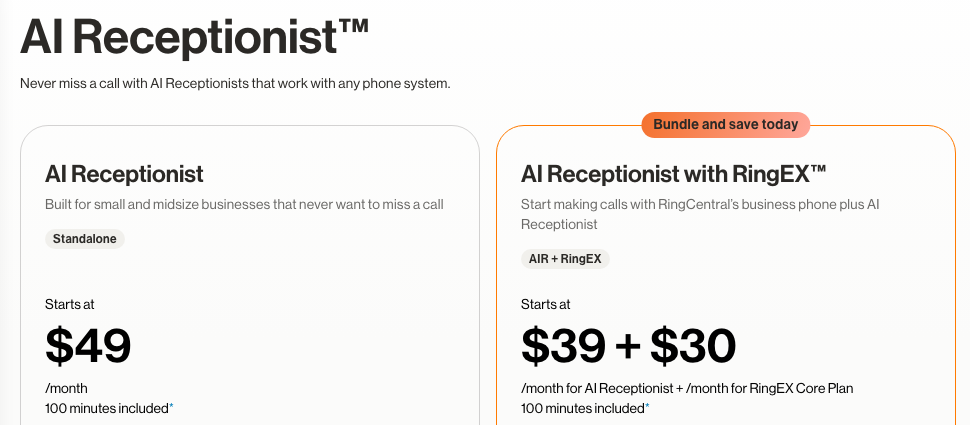
Source: RingCentral AI Receptionist pricing page, October 23, 2026.
Quo's Sona bills per call, from a free 10 calls a month to $199 for 600, on top of Quo's per-user plans (Quo pricing). GoTo Connect sells one too but doesn't publish the price. The catch with all of them: the AI sees your phone system, not your pipeline.
CRM and field-service add-ons know your customers and your calendar, which is their big advantage. Jobber's Receptionist is a $29 a month add-on, included on its Plus plan (Jobber pricing), and books visits from Jobber's own online booking. GoHighLevel's Voice AI is billed per minute or through its $50 and $97 AI plans. Our page on the GoHighLevel AI voice agent covers it.
Builder platforms like Vapi, Retell AI and Bland AI hand you the parts and bill by the minute, one of the seven ways to get an agent in our voice AI for business guide. You write the prompts and connect the calendar and CRM, so they suit a business with a developer. Owned agents run on your own hosting. More on that at the end.
AI vs human receptionist
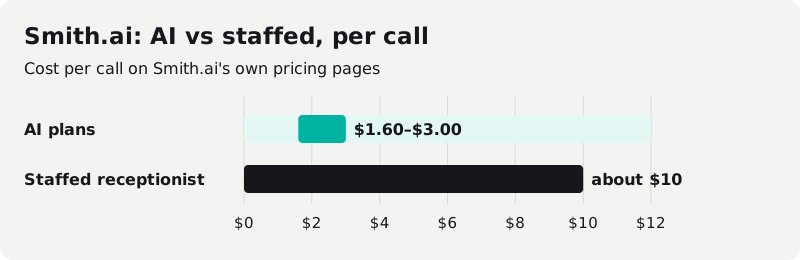
An AI receptionist costs a fraction of a human one per call and never misses a call to a lunch break, but a human handles judgment, upset customers and the unexpected far better. Smith.ai shows the gap on its own pages: its staffed receptionist plans start at $300 a month for 30 calls, about $10 a call, while its AI plans run $1.60 to $3.00 a call. Ruby's live receptionists start at $250 for 50 minutes (Ruby pricing).
A virtual receptionist (a remote human service) sits between the two. Many teams end up with both: AI answers first and transfers the calls worth a person's time.
Is an AI answering service the same thing?
An AI answering service and an AI receptionist are mostly the same product; "receptionist" just implies it books and answers questions as well as taking messages. The real choice is AI versus a live answering service, compared in AI phone answering service vs a live answering service.
How much does an AI receptionist cost?
An AI receptionist costs $0 to about $300 a month on self-serve plans, plus overage past the plan: roughly $0.45 to $3 a call, $0.50 a minute at RingCentral, or 15 to 79 cents per extra caller at Goodcall. Smith.ai's Enterprise AI plan is $500 a month, and Synthflow's enterprise contracts start at $30,000 a year.
The billing unit matters more than the sticker price, because each one punishes a different kind of month:
| Pricing model | Who uses it | What makes it expensive |
|---|---|---|
| Per call | Smith.ai, Upfirst, Quo, IONOS | Lots of short calls, and spam if it's billed |
| Per minute bundle | RingCentral, Rosie | Long calls and hold time |
| Per unique caller | Goodcall | Many one-time callers |
| Flat add-on | Jobber | Usually nothing, until a usage cap |
| Platform fee + usage | Vapi, Retell AI, Bland AI | Volume, since the fee rides on every minute |
Spam is the hidden line. Smith.ai filters known spammers and lets you strike up to 10% of calls as spam. Upfirst doesn't bill spam or calls under 15 seconds, and Quo skips calls under 15 seconds. Ask every vendor how a robocall shows up on your bill.
On builder platforms, the platform's own fee is about a third to two-fifths of each minute. Vapi charges $0.05 a minute for hosting and passes the AI models through at cost. Retell's voice engine is $0.055 a minute out of the $0.15 its estimator opens at.
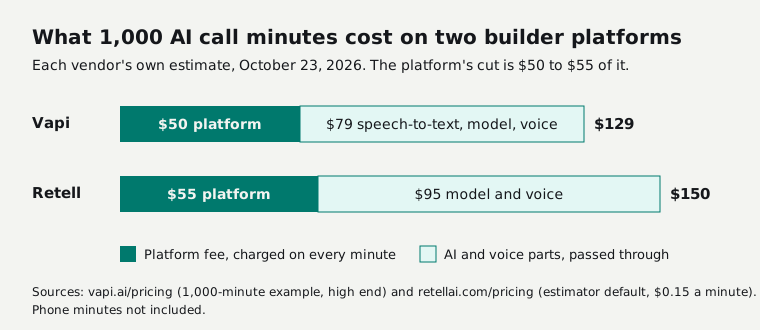
Worked bills for a real call volume, and the rent-vs-own math, are in our AI receptionist cost breakdown.
Is there a free AI receptionist?
Yes, a free AI receptionist exists, but only with a low cap. Smith.ai's free plan covers 25 calls a month, then $3.00 a call. Quo's free Sona tier covers 10 calls. Retell starts you with $10 in credits, and Bland's Start plan has no platform fee. Everyone else offers a trial: Upfirst 14 days with no card, Rosie 7 days, IONOS a free first month.
Are AI receptionists good?
AI receptionists are good at catching calls you'd otherwise miss and weak at sounding fully human, and setup decides most of the difference. The complaints repeat: the AI talks over callers or doesn't know when a call is over. A RingCentral customer posted exactly that in its community forum in March 2026: cut off mid-email address, and no hang-up after booking.
The best data on hang-ups comes from a vendor, so read it with that in mind. Upfirst analyzed 450,702 calls across 503 of its receptionists. Saying up front that it's an AI went with about 20% fewer hang-ups. Receptionists that could book, transfer and text, and were trained on the business, had roughly 30 to 40% lower odds of a hang-up. Greetings that opened with "the owner isn't available" had about 50% higher odds. Settings explained only about 13% of the gap between businesses, since many hang-ups are junk calls.
Our read: give it real jobs, tell callers it's an AI, and send anything tricky to a person. An AI receptionist that only takes messages is a fancier voicemail.
AI receptionist features to check before you buy
The AI receptionist features that matter most are calendar booking, warm transfers of hot leads, and getting your recordings and transcripts out. Check these before you sign:
- Booking: does it write to your calendar, or just text a link?
- Transfers: warm, with a summary, to which numbers and when?
- Hookups: your CRM and calendar, natively or through Zapier?
- Concurrency: Vapi's free tier takes 4 calls at once, Retell includes 20.
- Languages: two at Rosie, 35+ at Upfirst.
- Your data: none of the vendor pages we read says how to export recordings and transcripts. Ask in writing.
- Contract: most are monthly. Smith.ai asks for 30 days' notice.
Our vendor-by-vendor picks are in the best AI receptionist roundup.
AI receptionist for contractors and home services
An AI receptionist for contractors and home services should book jobs into the schedule you already run, which is why field-service add-ons like Jobber's are a strong pick there. A standalone service fits a shop whose schedule lives in Google Calendar. Our AI receptionist for small business guide picks by business size and budget.
Call recording laws for AI receptionists
Call recording laws apply to AI receptionists because they record or transcribe the call. Federal law allows recording when one party consents (18 U.S.C. 2511(2)(d)), and the business answering is a party, but some states require every party's consent. This isn't legal advice. Check your states with a lawyer.
Two-party consent states
Two-party consent states require everyone on the call to agree to a recording. The statutes in Florida (934.03), Maryland (10-402), Massachusetts (c. 272, s. 99) and Washington (9.73.030) say so, and other states, California among them, are often listed too. Your AI answers callers from every state, so put a short "this call may be recorded" line in the greeting.
AI disclosure laws
AI disclosure laws for inbound calls are still thin. Utah requires a business using generative AI with a consumer to disclose it when the person clearly asks whether they're talking to AI, and licensed professions must disclose it at the start of high-risk interactions (Utah SB 226, 2025). Disclosing at the start of every call is the simple rule, and it costs you nothing.
AI phone call laws for callbacks
AI phone call laws get much stricter when the AI makes the call. The FCC ruled in 2024 that AI-generated voices count as an "artificial or prerecorded voice" under the TCPA, so AI calls need the person's prior express consent, and the message must identify the business (FCC 24-17). That covers callbacks and follow-ups the AI places, not only cold calls, so check consent before you automate any of them. See AI cold calling and our TCPA rules for sales calls.
How to set up an AI receptionist
You set up an AI receptionist in five steps. IONOS says under 15 minutes; a good setup takes a few days of testing.
- Pick when it answers: all calls, after hours only, or after a set number of rings.
- Teach it your business: website, services, hours, and the questions callers really ask.
- Set the handoffs: which calls transfer, to whom, and when it takes a message instead.
- Connect your calendar and CRM so bookings and leads land where your team works.
- Call it yourself with real questions, odd questions and a bad connection. Then forward your number.
Build your own AI receptionist
You can build your own AI receptionist on a builder platform or as an owned agent, and owning makes sense once call volume is high and the AI needs your real customer data. Below that, rent one. A business answering a few hundred calls a month with simple needs is better off on a $50 to $150 plan.
Every AI receptionist rents the same raw parts. An inbound phone minute is $0.0085 at Twilio, and a local number $1 a month at Telnyx. Deepgram sells a complete voice-agent minute for $0.075. Platforms and services charge their fee on top, for as long as you use them. A builder platform cuts that markup, but you still pay its fee and do the building. Compare them in Vapi alternatives, Retell AI pricing and Bland AI pricing.
A custom AI receptionist is the other route. We build the agent (conversation logic, scripts, calendar and CRM hookups, call logs) on hosting you own. The phone line and AI minutes are utilities billed at cost with no platform markup, and you can swap either vendor. Every agent still rents a carrier and an AI model. You own everything above that layer, including the code, the data and the IP. It pays when the AI should read your real pipeline, because an agent bolted onto one tool only knows that tool, the problem we cover in GoHighLevel AI. What it costs: typically less than you spend today, paid monthly, with build payments that have an end date. Here's how pricing works.
Sources
All checked October 23, 2026. Prices change, so check the vendor's page before you buy.
- RingCentral AI Receptionist and pricing
- Quo pricing
- Smith.ai AI Receptionist pricing and receptionist pricing
- Upfirst pricing, Goodcall pricing, Rosie pricing, IONOS AI Receptionist
- Ruby pricing, Jobber pricing, HighLevel AI product pricing
- Vapi pricing, Retell AI pricing, Bland AI pricing, Synthflow pricing
- Twilio US voice pricing, Telnyx voice pricing, Deepgram pricing
- Upfirst hang-up study (vendor data, updated June 16, 2026)
- 18 U.S.C. 2511, FCC 24-17 (adopted February 2, 2024), Utah SB 226 (effective May 7, 2025), and the recording statutes for Florida, Maryland, Massachusetts and Washington linked above
The SaaS cost calculator adds up your phone, CRM and AI tools in about two minutes. If they come to a few thousand a month, book a free audit and we'll show you what one owned system would replace.
Frequently asked questions
How much does an AI receptionist cost?
Most self-serve AI receptionists cost $25 to $300 a month, and several have a free tier. Past the plan you pay per call (about $0.45 to $3), per minute ($0.50 at RingCentral) or per new caller. Managed plans and enterprise platforms run from $500 a month up.
What does an AI receptionist do?
An AI receptionist answers your business calls 24/7, answers common questions from your own information, books appointments on your calendar, takes messages, and transfers urgent or high-value calls to a person with a summary. Most also text the caller afterward and log a transcript.
How much is an AI receptionist worth?
An AI receptionist is worth whatever the calls you miss today are worth. If one booked job pays for a month of the plan, and you miss calls after hours or while your team is busy, it pays for itself fast. If you already answer nearly every call, it's worth little.
Is there a free AI phone receptionist available?
Yes, with low caps. Smith.ai's free AI plan covers 25 calls a month and Quo's free Sona tier covers 10. Most others offer a free trial instead, usually 7 to 30 days. Builder platforms like Retell and Bland let you start free and pay per minute.