
Short answer
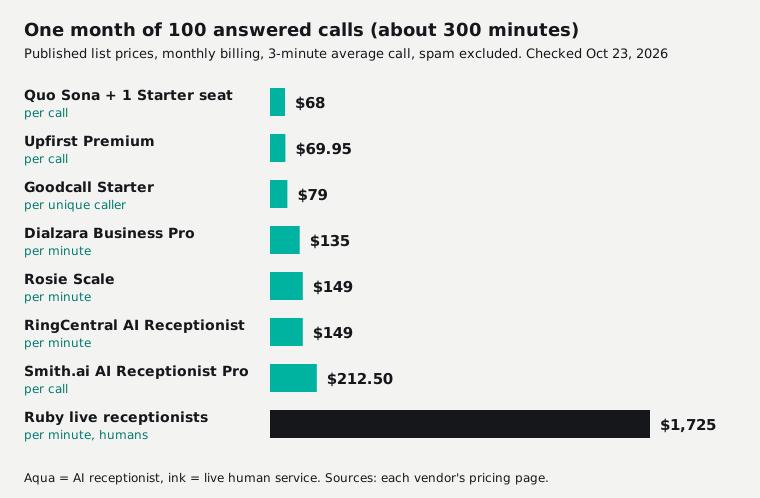
An AI receptionist for a small business answers every call, books the job or takes the message, and texts you a summary. At 100 calls a month it costs about $68 to $213 at published prices, and most plans land under $150. A live answering service handling the same calls costs $1,725 a month at Ruby.
Which one fits depends on how many calls you get, what those calls need (a booking, a person, or a lead captured) and which software you already run. Every price below comes from the vendor's own pricing page, checked October 23, 2026.
| Your situation | What fits | Monthly cost |
|---|---|---|
| Under 50 calls, mostly after hours | A per-call plan (Upfirst Starter, Smith.ai Free) | $25 to $45 |
| Trades or home services already on Jobber | The Receptionist add-on inside Jobber | $29 on top of your plan |
| Booking-heavy, 100 to 300 calls | A minute plan with calendar booking (Rosie Scale, Dialzara) | $135 to $350 |
| Calls that need routing to staff | An add-on to your phone system (RingCentral, Quo) | $44 to $450 |
| Professional services that want a human backstop | AI with live-agent transfer (Smith.ai) | $45 to $500 |
| Thousands of minutes, several locations or your own systems | A build platform or an owned agent | Usage at cost plus the build |
What does an AI answering service for small business do?
An AI receptionist, or AI answering service, picks up your business line in a natural voice, answers common questions from what you've taught it, books appointments, sends callers to the right person and texts you a summary of every call. How it works is in our AI receptionist guide.
You can put it on every call, only on calls nobody picks up, or only after hours; Upfirst offers all three on every plan. Missed calls and after hours is the low-risk way in.
Best AI receptionist for small business: match it to your calls
The best AI receptionist for a small business is the one that bills the way your calls arrive and does the one job your calls need most: booking, routing or capturing leads. Our best AI receptionist roundup compares the vendors one by one. Here, the job is matching one to your calls.
Start with how the vendor bills. Per call (Upfirst, Smith.ai, Quo) suits long calls, because a 9-minute call costs the same as a 2-minute one. Per minute (Rosie, Dialzara, RingCentral) suits short, quick calls. Per caller (Goodcall counts unique customers a month) suits businesses where the same people call back often. Then check spam: Upfirst doesn't bill spam or calls under 15 seconds, and Goodcall doesn't count spam or wrong numbers. Unfiltered spam bills like a customer.
Best AI receptionist for scheduling appointments
If most calls should end in a booking, pick a plan that writes straight into your calendar, not one that texts a link. Rosie's $49 Professional plan only sends booking links by text. Direct calendar booking and live transfers start on Scale at $149 a month for 1,000 minutes. Upfirst books into Google, Outlook, Clio, Acuity, Calendly and Square on every plan, from $24.95 a month for 30 calls.
Call routing and live transfers
If callers mostly need a person, you want routing by intent and warm transfers more than booking. RingCentral's AI Receptionist routes by name or intent to users, queues or outside numbers and passes context on the handoff. Check the tier: Dialzara lists blind and warm transfers on its $349 Business Elite plan.
AI receptionist software that feeds your CRM
For capturing leads, the question is where the caller's details land. RingCentral connects to Salesforce, Zoho and HubSpot. Rosie and Upfirst reach a CRM through Zapier, which works but adds one more tool that can break.
After-hours answering service
An after-hours answering service is the cheapest job to hand an AI receptionist, because those calls are mostly messages and bookings. Forward after hours only and give it an emergency rule: who gets a call at 2 a.m., and for what.
AI receptionist for business: which industries fit
The right AI receptionist for a business changes by industry, because a furnace that quit, a buyer asking about a listing and a shopper asking if a fridge is in stock need different things.
| Industry | Most calls are | Look for |
|---|---|---|
| Home services and trades (HVAC, plumbing, electrical) | Booking and urgent jobs | Booking into your job software, an emergency transfer rule |
| Real estate | New leads and showing requests | Fast lead capture, routing to the listing agent |
| Law firms and professional services | Intake and callbacks | Intake questions, Clio booking, a human backstop |
| Retail and appliance stores | Hours, stock, delivery | Answers from live inventory, or a quick transfer |
| Auto dealerships | Sales vs service | Routing by intent |
AI receptionist for contractors and plumbers
Contractors on field-service software should look there first. Jobber's Receptionist books visits using your existing online booking settings, creates work requests and texts back callers who hang up, and it's a $29 a month add-on (included on Jobber's Plus plan). Jobber doesn't publish a minute or call limit. Housecall Pro's CSR AI books jobs and covers nights and weekends, but its price isn't on Housecall Pro's site.
AI receptionist for law firms
Law firms usually want intake and booked consultations with a person behind the AI. Smith.ai's AI Receptionist can hand any call to a live North America-based receptionist and integrates with Clio. It's free for 25 calls a month, then $3 a call; Pro starts at $150 for 75 calls.
AI receptionist for real estate
For real estate teams, speed to the right agent on a new-lead call matters more than booking. A phone-system add-on with routing (RingCentral, or Quo's Sona for teams already on Quo) usually beats a stand-alone service here.
AI receptionist for retail
Retail and appliance stores have the hardest version of the job. The calls are "is it in stock" and "when does it deliver," and a rented receptionist answers from a FAQ, not your live inventory. That's where rented ones fall short.
How much does an AI receptionist cost for a small business?
At published prices, an AI receptionist costs a small business about $40 to $150 a month at 40 calls, $68 to $213 at 100 calls and $129 to about $500 at 300 calls. A live answering service costs $720 for 200 minutes and $1,725 for 500 minutes at Ruby. Our AI receptionist cost breakdown has the full math.
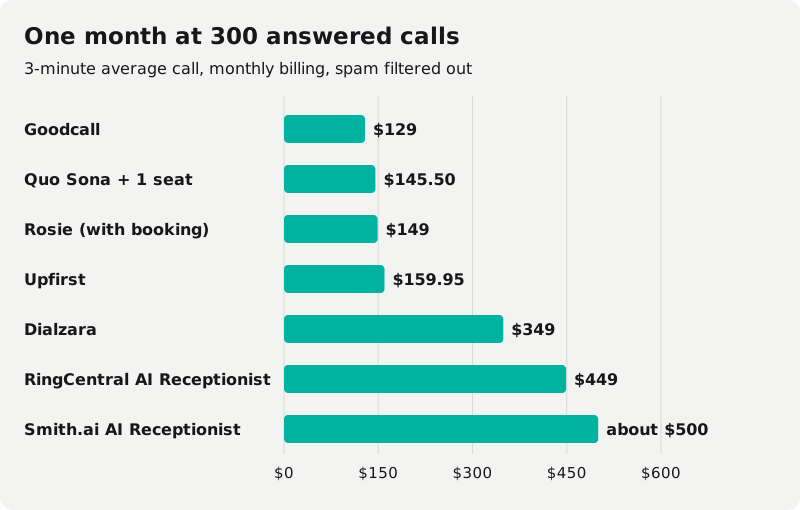
These bills assume a 3-minute average call, monthly billing and spam filtered out:
| Monthly bill | 40 calls | 100 calls | 300 calls |
|---|---|---|---|
| Upfirst | $39.95 | $69.95 | $159.95 |
| Goodcall | $79 | $79 | $129 |
| Quo Sona + 1 seat | $44 | $68 | $145.50 |
| Dialzara | $57.80 | $135 | $349 |
| Rosie (with booking) | $149 | $149 | $149 |
| RingCentral AI Receptionist | $59 | $149 | $449 |
| Smith.ai AI Receptionist | $45 | $212.50 | about $500 |
Goodcall assumes mostly new callers; repeat callers cost less. Quo includes one $19 Starter seat, since Sona only works inside Quo. RingCentral climbs fast past 100 included minutes, at $0.50 a minute rounded up to 30 seconds. Rosie's flat $149 covers 1,000 minutes, one of the cheapest booking options at volume.
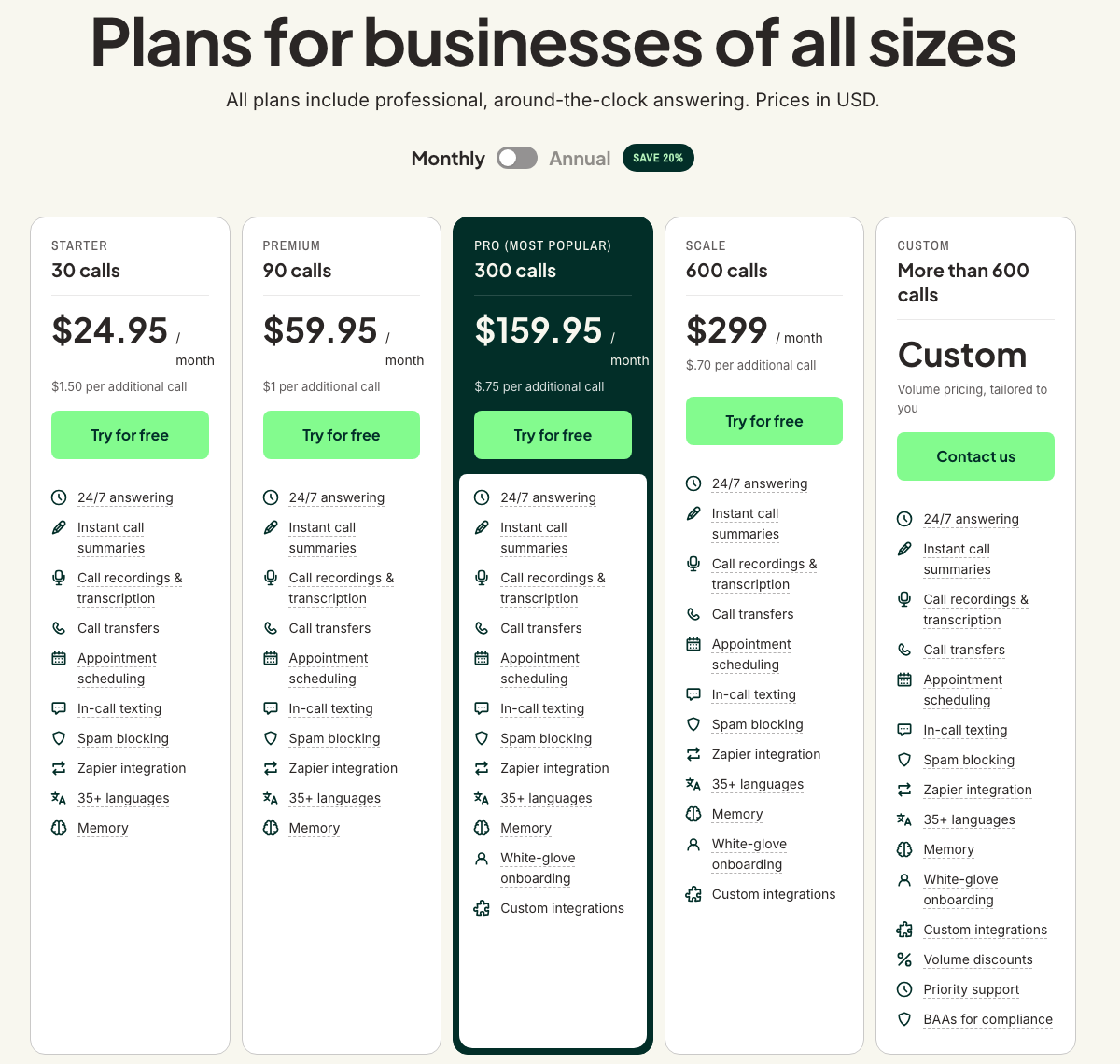
Source: Upfirst pricing page, October 23, 2026.
Against people, an AI receptionist costs a small business a fraction of a human receptionist or live answering service and answers every call at once, while a human service handles messy, emotional or high-stakes calls better. At 200 minutes a month, Ruby's live receptionists cost $720. The same minutes cost $49 to $149 on most AI plans.
Pick humans when each call is complicated and worth a lot. Pick AI when calls are routine and volume swings. Some blend the two: Smith.ai's AI hands off to live agents, and Ruby adds AI features to its human plans. More in AI phone answering service vs a live answering service.
AI receptionist setup: what it takes
AI receptionist setup takes minutes to a few hours: Housecall Pro says you're live in minutes once calls forward, and Jobber's needs no scripting. You forward your existing number, load your business details and test it before customers reach it.
- Feed it your real answers. Hours, service area, prices you're willing to quote, and your policies. Rosie trains from your Google profile and website, and Jobber's Receptionist uses what's already in your Jobber account.
- Connect the calendar it books into, and set what it may book.
- Write the transfer rules: who gets which calls, and the emergency rule.
- Forward the number: all calls, missed calls only, or after hours.
- Test it. Smith.ai includes test and simulated calls on every plan. Call it yourself and ask the questions your customers ask.
If the agent records and transcribes calls, have it say so at the start. Federal law allows recording with one party's consent (18 U.S.C. 2511), but some states, Florida among them, require everyone's. If it calls or texts leads back, those are calls you make. The FCC treats AI-generated voices as an "artificial or prerecorded voice" under the TCPA (FCC 24-17), so consent rules apply. This isn't legal advice; our TCPA rules for sales calls cover the details.
Is an AI receptionist worth it? Pros and cons
An AI receptionist is worth it for a small business that misses routine calls it could turn into jobs: at $40 to $150 a month, one extra booked job usually covers it. The cons are wrong answers when it's under-trained, callers who want a person, and bills that jump on spam or overage. Most of what goes wrong traces back to setup:
- Thin training. It answers from what you gave it. Missing prices or policies produce vague or wrong answers.
- Booking that isn't booking. An entry plan that texts a link leaves the caller to finish the job.
- No way out. Without a transfer rule, an angry or urgent caller gets stuck in a loop.
- Bill surprises. Unfiltered spam, per-minute plans with long calls, and overage like RingCentral's $0.50 a minute. Quo lets you cap usage; use caps where you can.
- Lock-in. Quo's Sona works only within Quo, and Jobber's only within Jobber. Leave the host and the agent goes with it.
Read a week of transcripts after launch to find the questions it fumbles.
AI voice agent for small business: rent or build an AI receptionist?
For most small businesses, renting an AI receptionist is the right call. (What sits inside one is in what is an AI voice agent.) At a few hundred dollars a month or less, no owned build pays for itself, and the services above are quick to set up and easy to cancel.
The math changes at scale. Build platforms like Retell ($0.07 to $0.31 a minute) and Vapi ($0.05 a minute hosting plus the speech, model and phone costs) sit close to raw cost, which runs roughly $0.04 to $0.09 a minute at published rates, with Twilio inbound at $0.0085. Rented receptionists charge their fee on top, for as long as you use them. Our Vapi alternatives compare the build platforms.
Owning makes sense when the agent needs your own data (live inventory, job status, customer history) that a rented service can't reach, when you run thousands of minutes or several locations, or when it's part of replacing a software stack that already costs a few thousand a month. In an owned agent, the kind we build, the scripts, integrations and call records run on your hosting, and the phone line and AI minutes are utilities billed at cost. You still rent a carrier and an AI model; you own everything above that. The whole system typically costs less than you spend today, with no seat fees. Here's how pricing works.
Sources
All checked October 23, 2026. Prices change, so check the vendor's page before you buy.
- Upfirst pricing
- Rosie pricing
- Dialzara pricing
- Goodcall pricing
- Smith.ai AI Receptionist pricing
- RingCentral AI Receptionist pricing
- Quo pricing and Sona
- Jobber Receptionist and Jobber pricing
- Ruby pricing
- Retell AI pricing, Vapi pricing, Twilio US voice pricing
- 18 U.S.C. 2511 and FCC declaratory ruling 24-17
The SaaS cost calculator adds up your phone, CRM and answering bills in about two minutes. If they come out at a few thousand a month, book a free audit and we'll show you what one system would replace.
Frequently asked questions
How much does an AI receptionist for small business cost per month?
At list prices checked in October 2026, a small business taking 100 calls a month pays about $68 to $213 for an AI receptionist, depending on how the vendor bills (per call, per minute or per caller), and about $40 at 40 calls. A live answering service for the same 100 calls costs $1,725 a month at Ruby.
Is there a free AI receptionist for small business?
A few have free tiers for very low volume. Smith.ai's AI Receptionist is free for 25 calls a month, then $3 a call, and Quo's Sona includes about 10 calls a month free on a paid Quo plan. Most others offer a 7 to 14-day free trial instead of a free plan.
Can an AI receptionist book appointments?
Yes. Most book straight into Google or Outlook calendars, Calendly or field-service software like Jobber. Check the plan, though: some entry tiers only text the caller a booking link, and direct calendar booking starts on a higher tier.
Does an AI receptionist sound human?
Current AI receptionists use natural voices, but some callers notice and ask for a person. Saying up front that it's an AI assistant and offering a quick transfer keeps those callers from hanging up.
Can I keep my business number with an AI receptionist?
Yes. Most stand-alone AI receptionists, and add-ons like Jobber's, work by forwarding calls from your existing number: every call, only the ones you miss, or only after hours. Phone-system add-ons like Quo's Sona only answer lines on that system.