Short answer
TCPA compliance for sales calls comes down to the calls, not the dialer. No federal rule bans power, predictive or parallel dialers; the rules regulate who you call, what consent you have, when you call, and how fast a rep picks up. A dialer sold as "TCPA compliant" still leaves those calls to you.
Two federal rule sets matter most: the TCPA (Telephone Consumer Protection Act), enforced by the FCC and through private lawsuits, and the FTC's Telemarketing Sales Rule (TSR). Many states add their own.
Not legal advice. This is our plain-English reading of the public rules as of October 20, 2026, with links to the source text. Rules change. Talk to a TCPA lawyer before you launch or change a calling program.
What is the TCPA law?
TCPA stands for the Telephone Consumer Protection Act of 1991, the federal law on telemarketing calls, robocalls, texts and fax ads (47 U.S.C. 227). For a sales team, it covers four things:
- Autodialed and prerecorded calls. No autodialed or prerecorded calls to cell phones, and no prerecorded calls to home lines, without the called person's prior express consent, unless it's an emergency (227(b)(1)). The FCC counts AI-generated voices as artificial voices under this rule, which is why AI cold calling needs consent too.
- Do Not Call. The FCC's Do Not Call rules come from 227(c), and people who get repeat calls in breach of them can sue.
- Caller ID. No misleading caller ID sent to defraud or cause harm (227(e)).
- Texts. A text counts as a call. The Supreme Court said a text message to a cell phone "qualifies as a 'call'" under the TCPA (Campbell-Ewald v. Gomez, 2016).
The FCC's rules that carry it out are at 47 CFR 64.1200.
TCPA compliance rules at a glance
| Rule | What it says | Source |
|---|---|---|
| Autodialer definition | Federal autodialers must be able to use a random or sequential number generator | Facebook v. Duguid (2021) |
| Consent | Written consent for autodialed or prerecorded telemarketing calls | 47 CFR 64.1200(a)(2) |
| One-to-one consent | One seller per consent | Struck down; never took effect |
| Opt-outs | Any reasonable method; honored within 10 business days | 47 CFR 64.1200(a)(10); FCC 26-67 changes the methods |
| Abandoned calls | A rep within 2 seconds; no more than 3% abandoned | 16 CFR 310.4; 47 CFR 64.1200(a)(7) |
| Calling hours | 8 a.m. to 9 p.m. in the called person's time zone | 16 CFR 310.4(c) |
| Do Not Call | The national registry and your own list | 47 CFR 64.1200(c), (d) |
| Recording | One-party consent federally; all-party in some states | 18 U.S.C. 2511 |
Is my dialer a TCPA autodialer?
It depends on what the equipment can do. The TCPA defines an automatic telephone dialing system as equipment that can store or produce numbers "using a random or sequential number generator" (47 U.S.C. 227(a)(1)).
In Facebook v. Duguid (April 1, 2021), the Supreme Court held that this capacity is "a necessary feature of an autodialer" (opinion). That narrowed the federal definition, but it doesn't settle whether your dialer is one. Some states define autodialers more broadly: Florida's law covers "an automated system for the selection and dialing of telephone numbers," and Oklahoma's is nearly identical. Ask a lawyer about your setup.
TCPA guidelines on abandoned calls (the 3% rule)
A call is abandoned "if a person answers it and the telemarketer does not connect the call to a sales representative within two (2) seconds of the person's completed greeting" (16 CFR 310.4(b)(1)(iv)).
Both agencies cap it at 3%. The FTC's safe harbor allows no more than 3% of answered calls per campaign or 30-day period, as long as you also let unanswered calls ring at least 15 seconds or four rings, play a recorded message with your name and number when no rep is free, and keep records (310.4(b)(4)). The FCC's limit is "three percent of all telemarketing calls that are answered live by a person, as measured over a 30-day period for a single calling campaign" (47 CFR 64.1200(a)(7)).
This is the rule that predictive and parallel dialers run into, because they dial ahead of the rep. Preview and manual dialing mostly avoid it. Parallel dialing isn't exempt: when two people answer at once and one is dropped, that's an abandoned call. See how each type of dialer works.
What TCPA consent do I need for sales calls?
Autodialed or prerecorded calls need the called person's "prior express consent." If the call is telemarketing, the FCC requires "prior express written consent": a signed written agreement that clearly authorizes those calls (47 CFR 64.1200(a)(2), (f)(9)). AI voice agents count as artificial voices (FCC 24-17), so the same consent applies to outbound platforms like Bland AI and its alternatives.
The penalty is why this matters. A person can sue for $500 per violation, and a court can triple it if the violation was willful (47 U.S.C. 227(b)(3)). Every call counts.
The one-to-one consent rule is not in force. The FCC's 2023 order would have limited each consent to "only one entity at a time." The Eleventh Circuit struck that down on January 24, 2025 (Insurance Marketing Coalition v. FCC). The FCC restored the earlier wording effective August 29, 2025 (90 FR 42137). As of October 20, 2026, the current rule text has no one-to-one limit.
TCPA regulations on opt-outs
Today people can revoke consent "by using any reasonable method," and you have to honor it "within a reasonable time not to exceed ten business days" (47 CFR 64.1200(a)(10)).
That is about to change. On September 30, 2026, the FCC adopted an order letting callers name one or more set opt-out methods: a key press or voice opt-out on the call, a reply text with a word like "stop," or a website or phone number the caller designates. Callers who do that must state the method on the call or in the text, and don't have to process requests made any other way (FCC 26-67). The 10-business-day limit stays.
For sales teams, the order's key line is that an opt-out from a telemarketing call or text covers all future telemarketing calls and texts from that caller. The looser "this category only" reading applies only to informational calls. The changes take effect 30 days after the order is published in the Federal Register. As of October 20, 2026, we found no publication yet, so check the FCC's notice for the date.
TCPA calling hours
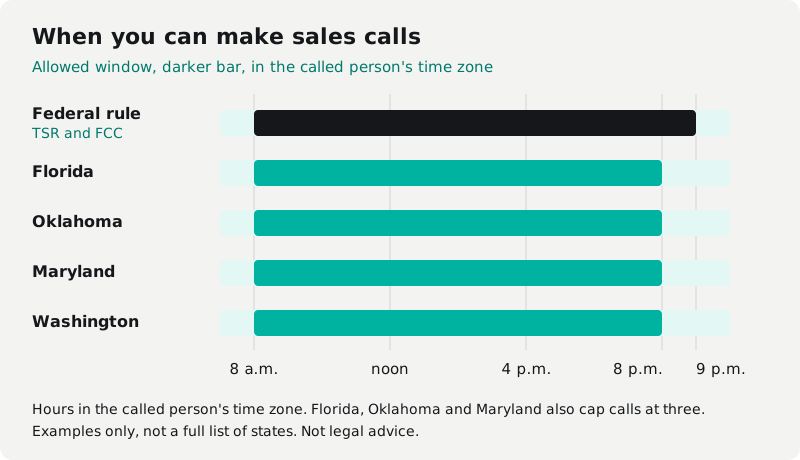
Federally, 8 a.m. to 9 p.m. in the called person's time zone, unless they've agreed otherwise (16 CFR 310.4(c); 47 CFR 64.1200(c)(1)). Several states are stricter (below). The TSR also requires you to send your phone number to caller ID, plus your name when your carrier supports it (310.4(a)(8)).
What do the Do Not Call rules require?
Two lists matter: the national registry and your own. National registrations "must be honored indefinitely, or until the registration is cancelled by the consumer" (64.1200(c)(2)).
For your own list, the FCC rule calls for a written policy and trained staff. A request must be honored within 10 business days and kept for 5 years (64.1200(d)). To use the TSR's safe harbor, scrub against a copy of the national registry no more than 31 days old (310.4(b)(3)). Don't count on your dialer vendor for this: Kixie and Aircall both leave DNC and consent to the customer.
Does the TCPA apply to B2B calls?
Partly. The TSR exempts many business-to-business calls, with exceptions such as calls selling nondurable office or cleaning supplies (16 CFR 310.6(b)(7)). The TCPA and state laws have their own rules, and the exemptions are narrow. Don't assume calling businesses makes you exempt.
State TCPA laws: what the mini-TCPAs add
Stricter hours, call caps and their own lawsuits. A few examples, not a full list:
- Florida. Automated calls need prior express written consent, and a person can sue for $500 per violation, up to three times that if willful (501.059). Calls only from 8 a.m. to 8 p.m., and no more than three calls in 24 hours to the same person on the same subject (501.616(6)).
- Oklahoma. A similar consent rule, 8 a.m. to 8 p.m., a three-call cap and a $500 private action, from the Telephone Solicitation Act of 2022 (HB 3168). Check the current text.
- Maryland. The Stop the Spam Calls Act of 2023: written consent for automated calls, no calls between 8 p.m. and 8 a.m., and a three-call cap (SB 90).
- Washington. No calls before 8 a.m. or after 8 p.m., and at least $1,000 per violation for a person hit by repeated violations (RCW 80.36.390).
More states have their own laws, and the list keeps changing.
Call recording laws for sales calls
Federal law allows recording when one party to the call consents (18 U.S.C. 2511(2)(d)). Some states require everyone's consent. We read that in the statutes for Florida (934.03), Maryland (10-402), Massachusetts (c. 272, s. 99) and Washington (9.73.030). California and other states are often listed too; check those statutes before you record. The same rules apply when an AI receptionist records or transcribes your inbound calls.
Is local presence dialing legal?
The FCC rules we read don't ban it by name. What the law bars is knowingly sending "misleading or inaccurate caller identification information ... with the intent to defraud, cause harm, or wrongfully obtain anything of value" (47 U.S.C. 227(e)). Call from numbers your business actually owns. For why calls get labeled "Spam Likely," see our dialer guide.
What are 5 major types of TCPA violations?
The rules above boil down to five ways sales teams break them:
- Autodialed or prerecorded calls or texts without the right consent.
- Calls to numbers on the national Do Not Call list or your own.
- Calls outside the allowed hours.
- Opt-outs not honored within 10 business days.
- Abandoned calls over 3%, or calls with no caller ID.
The first one carries $500 per violation, tripled if willful. Do Not Call breaches carry up to $500 per violation for a person who got more than one call in 12 months, and up to three times that if knowing or willful (47 U.S.C. 227(b)(3), (c)(5)). In a Do Not Call suit, a caller can defend itself by showing it had reasonable procedures in place to prevent those calls.
Frequently asked questions
What is prohibited by TCPA?
Without prior express consent, the TCPA bars autodialed or prerecorded calls to cell phones and prerecorded calls to home lines, except for emergencies. It also bars unsolicited fax ads, sales calls to numbers on the Do Not Call list, and caller ID spoofing meant to defraud or cause harm. This isn't legal advice.
What constitutes a call under TCPA?
Phone calls, and text messages too. The Supreme Court said in Campbell-Ewald v. Gomez (2016) that a text message to a cell phone qualifies as a call under the TCPA, so the consent rules for autodialed calls apply to texts.
Which calls are exempt from the TCPA?
Calls made for emergency purposes, and calls made with the called person's prior express consent, fall outside the autodialer and prerecorded-voice ban. FCC rules also exempt some prerecorded calls to home lines that aren't sales calls, such as non-commercial calls and calls from tax-exempt nonprofits, most of them capped at three calls in 30 days. Sales calls rarely qualify.
How much is a TCPA violation?
The statute lets a person sue for $500 per violation, and a court can triple that if the violation was willful.
Are auto dialers illegal?
No. No federal rule bans a type of dialer, but the calls it makes have to follow the rules on consent, calling hours, Do Not Call lists, abandoned calls and state law. This isn't legal advice.