

Short answer
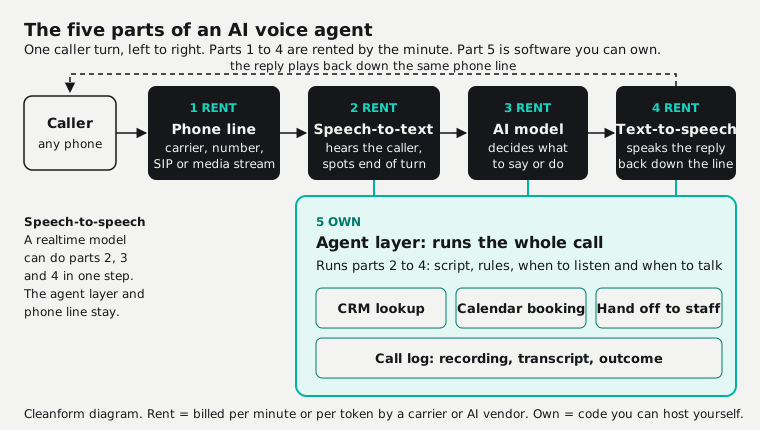
A conversational AI voice agent is software that answers or makes phone calls and talks like a person: it hears the caller, decides what to say, answers in a natural voice and can do things mid-call, like book an appointment or update your CRM. Every one of them is built from the same five parts: a phone line, speech-to-text, an AI model, text-to-speech and an agent layer that runs the call.
The first four parts are rented by the minute from carriers and AI vendors, and together they cost roughly 3 to 9 cents a call minute at published rates. The fifth part, the agent layer, is where voice platforms charge their own fee of about 5 to 8 cents a minute, and it's the part you can own. Prices below come from each vendor's own pricing page, checked October 23, 2026.
| AI voice agent at a glance | |
|---|---|
| What it does | Answers or places calls, talks in plain speech, takes actions during the call |
| The five parts | Phone line, speech-to-text, AI model, text-to-speech, agent layer |
| Raw cost of parts 1 to 4 | About 3 to 9 cents a call minute |
| Platform fee on top | About 5 to 8 cents a minute (Vapi, Retell, Telnyx, ElevenLabs and others) |
| What callers notice most | The pause before the agent answers, and whether it stops when they interrupt |
| What you can own | The agent layer: script, tools, CRM and calendar hookups, call logs |
| What you always rent | The carrier, phone numbers and the AI models |
What is an AI voice agent?
An AI voice agent is a program that holds a two-way phone conversation in natural speech and acts on it, instead of playing a menu. The caller says "I need to move my Thursday appointment," and the agent understands, checks the calendar, offers a new time and books it.
That's the difference from an IVR, the "press 1 for sales" menu that only accepts the inputs it was built for. A conversational agent takes open-ended speech and copes with interruptions, pauses and people changing their minds. If you mainly want one to answer your phones, see our AI receptionist guide.
How does a voice AI agent work?
A voice AI agent works as a loop that runs once per turn of the conversation: the phone line carries the caller's audio in, speech-to-text turns it into words, the AI model decides the reply or action, text-to-speech turns the reply into audio, and the agent layer controls the timing and runs any tools.
Phone line: SIP trunking and phone numbers
The phone line connects the agent to the phone network: a carrier such as Twilio or Telnyx provides the number and passes live audio to your software over SIP trunking (the standard for internet calls) or a media stream.
It's the cheapest layer. Twilio charges $0.0085 a minute inbound and $0.0140 outbound on a US local number, $1.15 a month for the number and $0.0044 a minute to stream the audio to your app. Telnyx lists SIP trunking from $0.0032 a minute inbound, numbers from $1 a month and media streaming at $0.0035 a minute plus a $0.002 Voice API fee.
Speech-to-text AI: hearing the caller
Speech-to-text (ASR) turns the caller's audio into text as they speak, and it also has the harder job of judging when the caller has finished.
Deepgram's streaming Nova-3 model costs $0.0048 a minute at its current promotional rate, and Flux, its model built for voice agents, $0.0065. AssemblyAI's Universal-Streaming is $0.15 an hour, a quarter of a cent a minute, billed on session time rather than speech time. Both now sell end-of-turn detection inside the transcriber. Deepgram quotes about 260 ms to detect the end of a turn on Flux.
The AI model: the best LLM for a voice agent
The AI model (a large language model, or LLM) reads the transcript, your instructions and the conversation so far, then writes the next reply or calls a tool. The best LLM for a voice agent is usually a small, fast one, because every extra half second of thinking is dead air.
Model prices are per million tokens (chunks of words), in and out: $0.75 and $4.50 for OpenAI's gpt-5.4-mini, $0.10 and $0.50 for Anthropic's Claude Haiku 5.5 on prompts up to 100,000 tokens, and $0.30 and $2.50 for Google's Gemini 3.5 Flash-Lite. Per call minute, Vapi passes OpenAI models through at cost for about $0.0077 to $0.0452 a minute.
Text-to-speech AI: the voice the caller hears
Text-to-speech turns the model's reply into audio and streams it back down the line before the full sentence is even written.
ElevenLabs charges $0.04 per 1,000 characters for its Flash and Turbo voices and $0.08 for v3 and Multilingual v2. Cartesia says one minute of audio uses 750 to 800 characters, so a fully spoken minute of a Flash voice costs about 3 cents. The agent only speaks for part of each call, so per call minute it lands lower: Vapi lists ElevenLabs at $0.0146 to $0.0238.
AI voice agent software: the agent layer
The agent layer is the software that runs the call: it holds the script and rules, decides when to listen and when to talk, calls tools mid-conversation and writes the call log. Tools are how a voice agent does work. The model asks for an action ("check Thursday's openings"), the agent layer runs it against your calendar or CRM and hands the answer back.
It also logs every call and handles transfers to a person. Voice platforms sell this layer, and since it's pure software, it's the one part you can own.
Speech-to-speech models
A speech-to-speech (or realtime) model hears audio and answers in audio, folding speech-to-text, the model and text-to-speech into one step. It can sound more natural, but you lose the text in the middle that lets you check each step, and it costs more.
OpenAI's gpt-realtime bills audio at $32 per million tokens in and $64 out, and Google's Gemini Live models $3 and $12. Retell lists speech-to-speech options at $0.07 to $0.38 a minute. The phone line and the agent layer stay either way.
What makes a conversational AI voice agent sound natural?
A conversational AI voice agent sounds natural when it answers within about a second, stops talking when the caller interrupts and waits until the caller has really finished. Latency, the gap between the caller stopping and the agent starting, is the biggest reason an agent feels robotic.
Voice vendors publish fast numbers for their own layer: about 75 ms for ElevenLabs Flash v2.5, excluding network time, and under 90 ms to first audio for Cartesia's Sonic. Waiting to be sure the caller has finished is usually the slow part.
Barge in and turn-taking
Barge-in means the caller can cut the agent off mid-sentence and the agent stops and listens. Without it, callers end up talking over a voice that won't stop.
The agent layer handles it with settings. In Vapi's speech configuration, the agent stops after the caller speaks for 0.2 seconds by default, can be set to ignore one- or two-word "okay"s and waits one second before resuming. Set it too sensitive and a cough or a TV in the background stops the agent.
Turn-taking is deciding when the caller has really finished. Vapi waits 0.4 seconds by default and suggests over a second on support calls, where people pause mid-thought. End-of-turn models such as Deepgram Flux judge from the words instead of a fixed timer. Deepgram's eager mode starts replying early, and Deepgram warns it can raise model calls by 50 to 70%.
AI voice agent pricing: cost per minute by layer
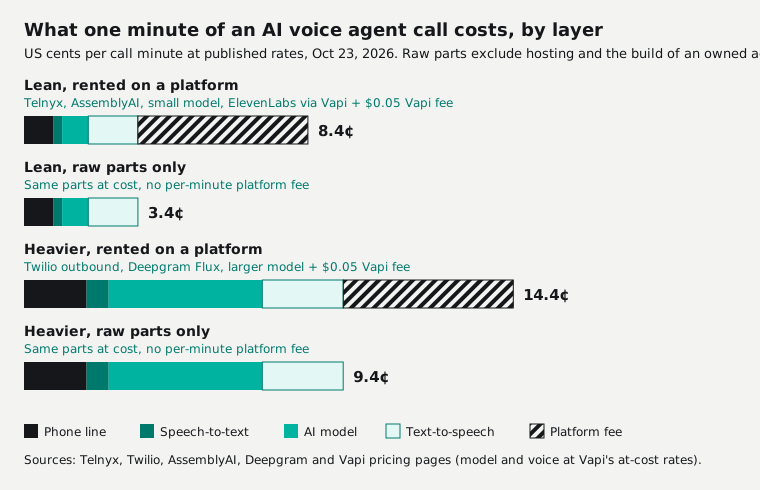
AI voice agent pricing comes to about 3 to 9 cents a call minute for the raw phone line, speech-to-text, model and voice at published rates, plus a platform fee of about 5 to 8 cents a minute if you build on a voice agent platform. On a lean setup, the platform fee is more than the other four parts combined.
| Per call minute | Low end | High end |
|---|---|---|
| Phone line | $0.0087 Telnyx in | $0.0184 Twilio out |
| Speech-to-text | $0.0025 AssemblyAI | $0.0065 Deepgram Flux |
| AI model | $0.0077 | $0.0452 |
| Text-to-speech | $0.0146 | $0.0238 |
| Raw parts total | $0.034 | $0.094 |
| Platform fee | $0.05 | $0.08 |
Phone rates include streaming the audio to the agent. Model and voice ranges are Vapi's at-cost rates for OpenAI models and ElevenLabs voices.
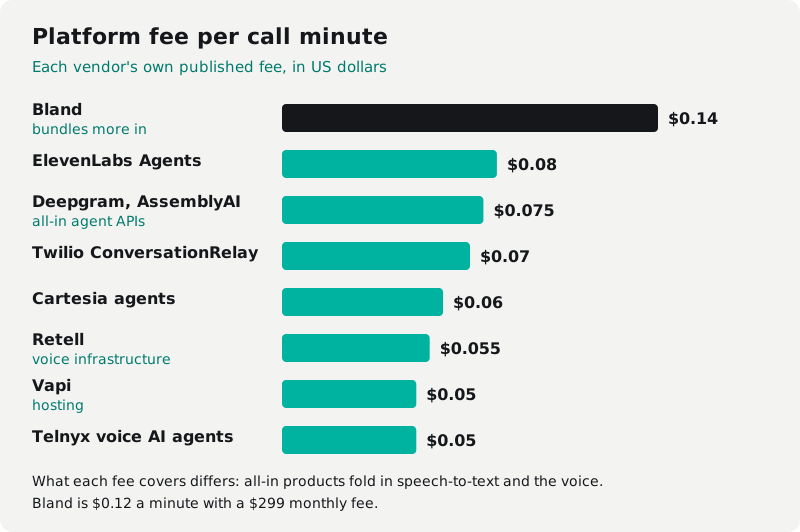
The platform fees: Vapi charges $0.05 a minute in hosting and passes models through at cost. Retell charges $0.055 for its voice infrastructure, and Telnyx's own voice AI agents $0.05, both with the model and phone line extra. Cartesia's agents are $0.06, Twilio's ConversationRelay $0.07, Deepgram's and AssemblyAI's all-in agent APIs $0.075 and ElevenLabs Agents $0.08. Bland bundles more into $0.14 a minute, or $0.12 with a $299 monthly fee. The all-in agent products fold speech-to-text and the voice into that fee, so compare what each minute covers.
So the fee matters with volume. At 3,000 minutes a month, a 5-cent fee is $150: rent. At 30,000 minutes it's $1,500 a month on top of the raw costs. Receptionist-specific pricing is in our AI receptionist cost breakdown, and platform-by-platform comparisons are in Vapi alternatives.
Build your own AI voice agent: what you own vs rent
You can build your own AI voice agent, but only part of it can be yours. The phone network, numbers and AI models are always rented. The agent layer (script, tools, CRM and calendar hookups, recordings and transcripts) can be owned and hosted on your own account.
| Part | Own or rent | Why |
|---|---|---|
| Phone line and numbers | Rent | Only carriers connect to the phone network |
| Speech-to-text | Rent (swappable) | Billed per minute; any vendor plugs in |
| AI model | Rent (swappable) | Billed per token; switch models without rebuilding |
| Text-to-speech | Rent (swappable) | Billed per character or minute |
| Agent layer, tools and call logs | Own | It's software; open-source frameworks exist |
Two open-source frameworks do the agent layer's heavy lifting: Pipecat, under the BSD-2-Clause license, and LiveKit Agents, under Apache-2.0. Both self-host, and LiveKit ships a turn detector and interruption handling by default.
That's how we build voice agents: the agent, its scripts, the CRM and calendar connections and every recording live on the client's own hosting, and the phone line and AI minutes are utilities billed at cost, from vendors you can swap. It typically costs less than you spend today, paid monthly, and the build payments have an end date. Here's how pricing works. Renting is the better call if your volume is low or the job is simple, like answering after-hours calls with a few questions.
AI voice agent for customer service and sales calls
An AI voice agent handles inbound calls for customer service and outbound calls for sales follow-up with the same five parts. What changes is the job, the script and the rules.
AI answering phone calls
Inbound is where most businesses start: answering when the team is busy or closed, qualifying callers, booking appointments and transferring hot calls to a person. Our AI phone answering service guide compares that with a live answering service.
AI outbound calling agents
Outbound agents call people back, confirm appointments, follow up on quotes and reactivate old leads. In the US, the FCC ruled in February 2024 that AI-generated voices count as an "artificial or prerecorded voice" under the TCPA, so these calls need the person's prior express consent, and prior express written consent if they're telemarketing (FCC 24-17). Recording rules apply too. Federal law allows recording with one party's consent, but some states, such as California, require every party to agree. This isn't legal advice. Our TCPA rules for sales calls and AI cold calling guides cover outbound in depth.
The challenge with AI voice agents
AI voice agents still struggle with noisy lines, heavy accents, long pauses and callers who interrupt a lot, and a model can state something wrong with full confidence.
Keep the agent's job narrow, give it a fast way to transfer to a person, have it read facts from your systems instead of guessing, and listen to the recordings for the first few weeks. Watch short calls too: Telnyx rounds each agent call up to a full minute, so a 10-second hang-up bills 60.
Sources
All checked October 23, 2026. Vendors change prices often, so check the page before you buy.
- Twilio Voice pricing, US
- Telnyx Elastic SIP pricing, Voice API pricing, number pricing and voice AI agent pricing
- Deepgram pricing and Flux docs
- AssemblyAI pricing
- OpenAI API pricing
- Anthropic Claude pricing
- Google Gemini API pricing
- ElevenLabs API pricing and models
- Cartesia pricing and Sonic
- Vapi pricing and speech configuration
- Retell AI pricing
- Bland AI pricing
- Pipecat, LiveKit Agents and LiveKit turn handling
- FCC declaratory ruling 24-17 (adopted February 2, 2024)
- 18 U.S.C. § 2511 and California Penal Code § 632
The SaaS cost calculator adds up what your phones, CRM and AI tools cost today. If it comes to a few thousand a month, book a free audit and we'll show you what an owned system would replace.
Frequently asked questions
What is an AI voice agent?
An AI voice agent is software that holds a real phone conversation. It hears the caller with speech-to-text, decides what to say with an AI model, answers in a synthetic voice with text-to-speech, and can act during the call, such as booking an appointment or updating a CRM record.
How much does an AI voice agent cost?
The raw parts (phone line, speech-to-text, AI model and voice) cost roughly 3 to 9 cents a call minute at vendors' published rates in October 2026. Voice agent platforms add their own fee on top, about 5 to 8 cents a minute for most of them.
Can an AI voice agent make outbound calls?
Yes. The same agent can place calls from a list or a CRM trigger. In the US, the FCC ruled in 2024 that AI-generated voices count as an artificial or prerecorded voice under the TCPA, so outbound AI calls need the person's prior express consent, and written consent for telemarketing.
Can I build my own AI voice agent?
Yes. The agent layer is ordinary software, and open-source frameworks such as Pipecat (BSD-2-Clause) and LiveKit Agents (Apache-2.0) can be self-hosted. You still rent the phone line and the AI models by the minute, but you skip the platform's per-minute fee.
Can ChatGPT do voice AI?
OpenAI, the company behind ChatGPT, sells realtime speech-to-speech models through its API, such as gpt-realtime and gpt-realtime-mini, and developers use them inside voice agents. A phone agent still needs a phone line and an agent layer around the model to answer calls, book appointments and log each call.