

In this article
- What is TCPA compliance software?
- Is there a TCPA compliant dialer?
- TCPA dialer features, vendor by vendorHow much is a phone dialer, and what's extra?
- Predictive dialer TCPA rules: the 3% abandon rate
- DNC scrubbing software and the National DNC Registry
- Standalone TCPA compliance tools
- TCPA liability: is it on you or the dialer vendor?
- Do you need TCPA compliance software? The process matters moreCall recording disclosureTCPA compliant texting: STOP replies
- Should you own a TCPA compliant dialer?
- Sources
- Frequently asked questionsWhat is a compliance software?Who must comply with TCPA?Does TCPA cover business to business calls?What are the TCPA call requirements?What is an autodialer TCPA?
Short answer
No dialer or compliance tool makes a sales floor TCPA compliant. The software enforces the settings you switch on and the lists you load, and every vendor contract we've signed or read puts consent, Do Not Call scrubbing and calling rules on the customer.
What TCPA compliance software can do is take some jobs off your reps: block calls outside the legal hours, keep a predictive dialer under the 3% abandoned-call limit, check numbers against your do-not-call list before every dial, and keep the records. We checked ten dialers and the main standalone tools against their own docs and terms on November 4, 2026. This is not legal advice.
| Compliance job | What software can do | Who is still responsible |
|---|---|---|
| Calling hours | Skip leads outside 8 a.m. to 9 p.m. their time, once you switch it on | You set the window and state rules |
| Abandoned calls | Pace a predictive dialer to a target rate | You pick the target and keep it at 3% or under |
| Do Not Call | Block numbers on lists you load or subscribe to | You buy registry access and refresh it every 31 days |
| Consent | Store a record or a certificate | You get valid consent before the call |
| Recording | Play a notice, or skip recording in some states | You decide the rule per state and train reps |
| Opt-outs | Block texts after a STOP reply | You make sure calls stop too, within 10 business days |
What is TCPA compliance software?
TCPA compliance software is any tool that helps a sales team follow the Telephone Consumer Protection Act and the FTC's Telemarketing Sales Rule while calling or texting. It comes in three kinds: dialers with compliance settings (Kixie, JustCall, ReadyMode, PhoneBurner), contact-center platforms (Five9, Convoso, TCN), and standalone tools for one job, such as DNC scrubbing or consent proof.
None of the three kinds takes the duty off you. The rules in 47 CFR 64.1200 (FCC) and 16 CFR 310.4 (FTC) are written about the caller and the seller, and nothing in them lets you hand a duty to your software vendor. The tool is how you do the job faster. It isn't who gets sued.
That's my view after years of running outbound floors. Compliance is configuration plus process, and the software only covers the first half. The rules themselves, with their sources, are in our TCPA compliance guide.
Is there a TCPA compliant dialer?
A TCPA compliant dialer doesn't exist as a product you can buy and forget. A dialer can be run in a compliant way, but only after an admin sets the calling window, loads the right lists and keeps the abandon rate down. Out of the box, most of those controls are off or set to the vendor's default.
Only two jobs can be enforced by the software on its own once they're set: the calling-hours window and the abandoned-call pacing on a predictive campaign. Everything else depends on what you load and keep. A dialer can't tell whether the consent behind a lead is valid, which state lists you need, or whether a rep actually read the recording notice.
Some vendors use the phrase anyway. Kixie calls its features and numbers "100% FCC and TCPA compliant" in a 2021 article, and CloudTalk's TCPA dialer page promises "full TCPA compliance". Their contracts, quoted further down, still leave compliance with the customer. Read the marketing and the terms side by side before you buy.
TCPA dialer features, vendor by vendor
TCPA dialer features, the controls a TCPA auto dialer gives you, vary more than the marketing suggests. Per each vendor's own docs, checked November 4, 2026, JustCall, ReadyMode, Five9, Convoso and TCN document state-level calling rules, ReadyMode and Five9 document an abandon-rate setting, and Aloware says outright that it doesn't scrub the National DNC Registry. Every control in the table is something an admin turns on.
| Dialer | Calling hours | Do Not Call | Recording and consent | Abandon control |
|---|---|---|---|---|
| Kixie | No hours control found | National DNC is a paid Compliance Add-on, price not published | Two-party setting skips recording in listed states | Not documented |
| Aloware | One account-wide window, not per state | Internal list only, no registry scrub | Greeting and announcement per line | Not documented (power dialer) |
| JustCall | State slots for US, Canada, Australia, admin only | Do Not Dial list; registry scrub not specified | Recording toggle off in 15 all-party states, Pro and up | Not configurable in docs read |
| ReadyMode | State toggle, off until enabled | State restrictions incl. call limits; registry scrub not confirmed | Record all calls locked on, no state prompt found | Default 2.5%, editable |
| CloudTalk | "Time Zone Enforcement" (marketing only) | Blacklist, Expert plan | Records chosen calls, no consent prompt documented | Not documented |
| Aircall | Business hours only | DNC label, exclusion is manual | Pre-call announcement, admin toggle | N/A (power dialer) |
| PhoneBurner | Built-in calling-hour limits | Registry scrub via a separate DNC.com subscription | Not found | N/A (rep starts each call) |
| Five9 | State Dialing Rules per campaign | DNC list management, recommends outside scrubbers | Not found | 3% setting, warns on change |
| Convoso | StateTracker, state rules | Internal, federal and state lists checked before dialing | Scripted disclosures | Not on pages read |
| TCN | Rules by time zone, area code, state | Manually approved calls | Not on pages read | Not on pages read |
Sources are the vendor pages linked in the table, plus Five9's campaign administrator's guide, TCN's TCPA compliance guide and PhoneBurner's dialer comparison. "Not found" means the docs we could read don't describe it, not that the feature can't exist.
Details worth knowing before a demo:
- Kixie sells "DNC (Do Not Call)" as a Compliance Add-on outside all three plans, and its DNC page leaves customers responsible "for their calling practices". No seat or add-on prices are published.
- Aloware's do-not-contact status "is not the same as the FTC's National Do Not Call Registry", in its own help center's words. A STOP reply blocks texts to every number on the contact, but calls stay allowed until the contact is marked DNC.
- JustCall won't let anyone override a contact held back by time zone. Only the account owner and admins can set the windows, and the recording toggle covers outbound calls only.
- ReadyMode's state toggle skips a lead outside its window and defers the call. Recording is locked on by default, and changing it goes through ReadyMode's compliance team.
- CloudTalk's TCPA page names ten safeguards. None of them is a National DNC scrub, state lists, per-state hours or an abandon control, and the one with a help article, the blacklist, is Expert-plan only.
How much is a phone dialer, and what's extra?
Published plan prices for these dialers run about $25 to $183 a user a month on annual billing, and most compliance extras cost more on top or aren't priced at all. These are the rates on November 4, 2026:
| Dialer | Seat price a month (annual) | Compliance extras |
|---|---|---|
| CloudTalk | $25 / $29 / $49, power dialer +$15 | No DNC add-on listed |
| JustCall | $29 / $49 / $89, 2-seat minimum | State hours and recording toggle from Pro |
| Aircall | $30 / $50 | Power Dialer on Professional only |
| PhoneBurner | $140 / $165 / $183 | DNC.com scrub billed separately |
| Kixie, ReadyMode, Five9, Convoso, TCN | Quote only | Compliance add-ons not priced |
| Cleanform, owned, no seat fees | $0 | Hours and your DNC list built in |
Cleanform is $0 a seat at any team size: you pay monthly for the build until it's paid off, then mostly hosting. How pricing works.
For a wider price list, see our predictive dialer software comparison and the Kixie and Aircall breakdown.
Predictive dialer TCPA rules: the 3% abandon rate
A predictive dialer must keep abandoned calls at or under 3% of telemarketing calls answered by a live person, measured per campaign over 30 days. A call counts as abandoned when no rep connects within two seconds of the person's greeting, and a recorded message with your name and a callback number has to play (47 CFR 64.1200(a)(7)).
The dialer is the one place software can hold that line for you, if the target is set right. ReadyMode's dialing speed help page sets the abandon threshold at 2.5% by default "but you can change this to whatever you wish", and publishes no ceiling. When we ran floors on ReadyMode, it let us set the threshold as high as we wanted, up to 50%. Five9's guide goes the other way and warns you when you change the default.
Power dialers almost never abandon a call, and on PhoneBurner the rep starts each call, so the rule rarely bites. How the pacing works is in our predictive dialer guide.
DNC scrubbing software and the National DNC Registry
DNC scrubbing software checks your call list against the National Do Not Call Registry, state lists and your own do-not-call list before anyone dials. You still need your own registry subscription: the first five area codes are free, then $85 per area code a year from October 1, 2026, up to $23,425 for every area code (91 FR 54947). Lists must be refreshed at least every 31 days.
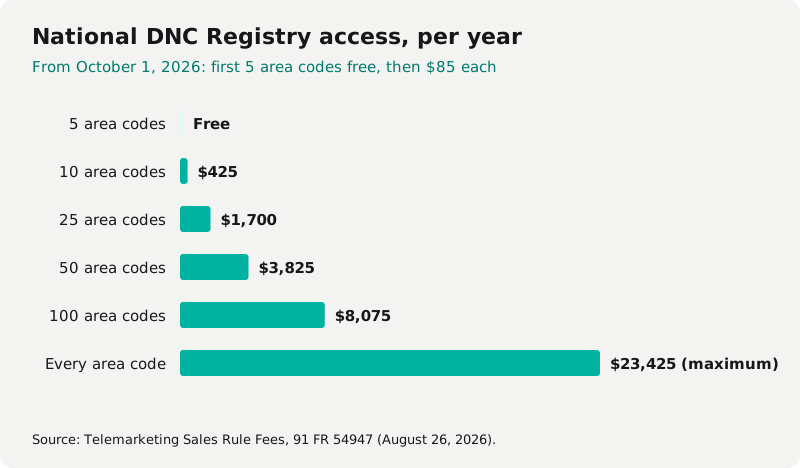
The registry is cheap next to seats. Who does the scrub is where dialers differ:
| Who scrubs | How it works | Price |
|---|---|---|
| Kixie | Compliance Add-on checks the National DNC and your list | Not published |
| PhoneBurner | DNC.com integration scrubs the registry and known litigators | Separate subscription, "discounted rates" |
| Convoso | Internal, federal and state lists before dialing | Quote only |
| Aloware, Aircall, CloudTalk | Your own list only | You scrub elsewhere |
| DNC.com DNCScrub | Federal, state, internal and litigator lists | Tiered by records, not published |
Five9 goes as far as recommending outside scrubbing partners in its Manual Touch datasheet. A scrub is a snapshot of the list on the day you run it. New leads and new registrations need the next one.
Standalone TCPA compliance tools
Standalone TCPA compliance tools each do one job that dialers mostly skip: prove consent, catch reassigned numbers, scrub litigators or review calls. They plug in next to your dialer. None of them sets your dialer's hours or abandon rate, and none can make a weak consent valid.
| Tool | Job | Published price (Nov 4, 2026) |
|---|---|---|
| TrustedForm Retain | Saves proof of a web-form opt-in | $0.12 to $0.06 a certificate, $10 a month minimum |
| Blacklist Alliance via LeadConduit | Flags known TCPA plaintiffs and litigators | $0.01 a scrub (reseller price) |
| DNC.com DNCScrub | Federal, state, internal and litigator scrub | Not published |
| FCC Reassigned Numbers Database | Checks if a number changed hands since consent | Current price not published on its site |
| AI call review (for example Enthu.ai) | Flags missing disclosures after the call | Not published |
TrustedForm's first-party rate is $0.12 a certificate for the first 1,000 and drops to $0.06 at volume, plus $0.0002 a certificate a month for storage. It records what happened on the web form. Whether that form's wording was valid consent is still your lawyer's call.
The reassigned-numbers check only protects you if you run it. Under 64.1200(m), a caller who gets a "no" from the database for that number and date isn't liable if the number had in fact changed hands, and the caller carries the burden of proving it.
TCPA liability: is it on you or the dialer vendor?
TCPA liability sits with the business making the calls, and dialer contracts say so in writing. All nine dialer vendors whose terms we could open make the customer responsible for consent, Do Not Call and calling rules, and most add an indemnity, so a claim against the vendor over your calls comes back to you.
| Vendor | Clause | What it says |
|---|---|---|
| ReadyMode | Terms 10.3 (updated July 23, 2026) | Customer "remains solely responsible, at all times, and liable" |
| JustCall | Terms s.4 | "solely responsible for complying with the TCPA Rules" |
| CloudTalk | Cl. 9.1 | "does not verify, monitor, or guarantee Customer's compliance" |
| PhoneBurner | TOS s.10 | "We are not Your compliance officer" |
| TCN | ToS s.12(c)(I) | Customer "MAKES" and "INITIATES" all calls |
| Aloware | TCPA section (c) | Each use is a warranty that consent was obtained |
| Kixie | Terms s.10 | Customer stays in compliance with the TCPA and TSR |
| Aircall | US terms s.10.5 | Customer "solely responsible" for consent and recording laws |
| Five9 | Required Terms s.7.a (reseller customers) | Customer "solely responsible" for required consents |
We couldn't read Five9's current Master Services Agreement or Convoso's customer agreement, which sits behind a login. That fits what we've seen on our side too: in every contract we've signed or read, 100% of the compliance responsibility sits with the customer.
The exposure is real money. The statute sets damages at $500 per violation, and a court can triple that to $1,500 if the violation was willful or knowing (47 USC 227). Each call or text can count as one.
Do you need TCPA compliance software? The process matters more
You need some TCPA compliance software, because a floor can't check hours, lists and consent by hand on every call. But software covers only part of the process. With 100 reps dialing, no manager can confirm the recording disclosure was given on every call and text consent was captured for every lead. That part needs a process, and a way to check it.
| Control | Rule | Can software do it? |
|---|---|---|
| Valid consent before marketing calls | 64.1200(a)(2) | Stores it, can't judge it |
| Registry scrub every 31 days | 310.4(b)(3)(iv) | Yes, with your subscription |
| Your own do-not-call list, kept 5 years | 64.1200(d)(6) | Yes |
| Calling hours, 8 a.m. to 9 p.m. | 64.1200(c)(1) | Yes, once enabled |
| Abandoned calls at or under 3% | 64.1200(a)(7) | Yes, on predictive |
| Opt-outs honored in 10 business days | 64.1200(a)(10) | Partly |
| Records kept 5 years | 310.5(a) | Yes, if you keep the data |
| Rep training and spot checks | 64.1200(d)(2) | No |
Every item, with its source, is in our TCPA compliance checklist, with a free PDF. One date to watch: the FCC's opt-out changes (FCC 26-67) take effect November 25, 2026, and let you name one opt-out method if you disclose it on the call or in the text.
Call recording disclosure
Neither the TCPA rules nor the FTC's rule require a recording notice. All-party consent duties come from state law, which is why JustCall and Kixie switch recording off for calls into listed states and Aircall and Aloware let you play an announcement. None of those settings proves the rep said the disclosure on a live call. Our rules guide lists the all-party states.
TCPA compliant texting: STOP replies
TCPA compliant texting starts with honoring STOP. Aloware and JustCall both block further texts after a STOP reply, but in Aloware calls stay allowed until the contact is marked do-not-contact. Under 64.1200(a)(10), a STOP reply revokes consent to further calls or texts from that caller, so check how your tool links the two.
Should you own a TCPA compliant dialer?
Owning a dialer makes sense when your dialer, CRM and compliance add-ons cost $2,000 to $3,000 a month or more. Under about $1,000 a month, keep renting: the controls in the tables above will do the job if you set them. Above that, you're paying per seat for settings you still configure yourself.
The dialers we build apply calling-hour limits in each customer's local time, by state, along with holiday and Sunday rules and per-state daily call limits where they apply. Numbers on your do-not-call list are blocked when a list is uploaded and again before every dial, and reps can mark a number do-not-call during a call. The dialer also tells the rep when they're calling into a two-party consent state. It checks your own do-not-call list, not the National Registry, so you keep your registry scrub.
We also build systems that check every call for the recording disclosure and the text-message consent, and send you a report card every week showing which reps follow the rules and which don't. These are tools that help you follow the rules. They are not legal advice, and you're still responsible for your own compliance.
On cost: typically less than you spend today, paid monthly, and the build payments have an end date. You own the code and the data. Here's how pricing works, and our guide to sales dialers compares the rest of the options.
Sources
Vendor pages, terms and federal rules checked November 4, 2026.
- 47 CFR 64.1200 (FCC), 16 CFR 310.4, 310.5 and 310.6 (FTC), 47 USC 227
- Telemarketing Sales Rule Fees, 91 FR 54947 (August 26, 2026)
- Kixie pricing, terms, National DNC page, two-party consent
- Aloware DNC rules, acceptable use, terms
- JustCall pricing, calling hours, recording compliance, terms
- ReadyMode terms, dialing speed, state calling restrictions
- CloudTalk TCPA page, pricing, terms
- Aircall pricing, outbound campaigns, US terms (PDF)
- PhoneBurner pricing, terms, DNC integration
- Five9 TCPA tools and Required Terms; Convoso compliance; TCN terms
- TrustedForm Retain pricing, DNC.com DNCScrub
The SaaS cost calculator adds up your dialer, CRM and the rest of your stack in about two minutes. If it comes out at a few thousand a month, book a free audit and we'll show you what one owned system would replace.
Frequently asked questions
What is a compliance software?
For outbound calling, compliance software is any tool that helps you follow the TCPA and the Telemarketing Sales Rule: dialer settings for calling hours and abandoned calls, Do Not Call scrubbing, consent records, reassigned-number checks and call review. It enforces what you switch on and load. It doesn't make you compliant, and every vendor contract we read leaves compliance with you.
Who must comply with TCPA?
Anyone who makes telemarketing calls or texts to US numbers, or uses an autodialer or a prerecorded voice to call cell phones, must follow the TCPA and the FCC's rules at 47 CFR 64.1200. A seller is also on the hook for calls a third party makes on its behalf. Your dialer vendor's terms say the same: the customer carries it. This is not legal advice.
Does TCPA cover business to business calls?
Partly. The FTC's Telemarketing Sales Rule exempts most calls to businesses (16 CFR 310.6(b)(7)), but the TCPA's rules on autodialed and prerecorded calls to cell phones apply whoever answers, and a business owner's personal cell can be on the Do Not Call Registry. Check your list before you treat it as B2B. This is not legal advice.
What are the TCPA call requirements?
The main ones for sales calls: call between 8 a.m. and 9 p.m. in the called person's local time, don't call numbers on the National Do Not Call Registry or your own do-not-call list, get prior express written consent before autodialed or prerecorded marketing calls to cell phones, keep abandoned calls at or under 3% per campaign over 30 days, and honor opt-outs within 10 business days. Our TCPA rules guide covers each one with its source.
What is an autodialer TCPA?
Under the TCPA, an autodialer (an automatic telephone dialing system) is equipment that can store or produce numbers using a random or sequential number generator and dial them. The Supreme Court read it that narrowly in Facebook v. Duguid (2021), so most list-based sales dialers aren't autodialers. Consent, Do Not Call, calling-hour and abandoned-call rules still apply to them.