

Short answer
A predictive dialer is outbound calling software that dials more numbers than you have free reps and connects only the calls a person answers. It guesses how many lines to dial from your answer rate and how long calls last, so reps go from one conversation to the next with little waiting.
The cost of that speed is the abandoned call: someone answers and no rep is free. That's why a predictive dialer needs a big team on one campaign, about 10 to 15 reps, and why federal rules cap abandoned calls at 3% of answered telemarketing calls. Vendor details and rules below were checked on October 29, 2026.
What is a predictive dialer?
A predictive dialer is software that dials several phone numbers for every rep who is about to be free, filters out the rings, busy signals and voicemails, and passes each live answer to a rep. "Predictive" refers to the guess at its core: it predicts when reps will finish their calls and dials ahead of them.
You'll also see it called a predictive dialer system or a predictive auto dialer. They mean the same thing. Five terms explain how it behaves:
| Term | What it means |
|---|---|
| Answer rate | Share of dials a live person picks up (often called hit rate) |
| Dial ratio | Lines dialed for each free rep |
| Talk time | How long reps stay on a call, which sets when they free up |
| Abandoned call | A person answers and no rep is free to take it |
| Answering machine detection | The dialer's guess at whether a person or a voicemail picked up |
Predictive dialing is one of four common modes. The others are power, parallel and preview, and our guide to auto dialers compares all of them.
How does a predictive dialer work?
A predictive dialer works in a loop: it measures how often calls get answered and how long they last, predicts how many reps will be free in the next few seconds, dials that number of reps times a dial ratio, and connects each live answer to the next free rep. The starting ratio is about 1 divided by the answer rate.
So at a 50% answer rate it dials about 2 lines per free rep, and at 25% about 4. The software keeps adjusting as answers come in. JustCall's predictive dialer estimates when each agent will wrap up their current call and dials ahead, up to 10 numbers at once. Close's predictive dialer adjusts from the number of reps available, dials per answer, the abandonment rate and conversation length.
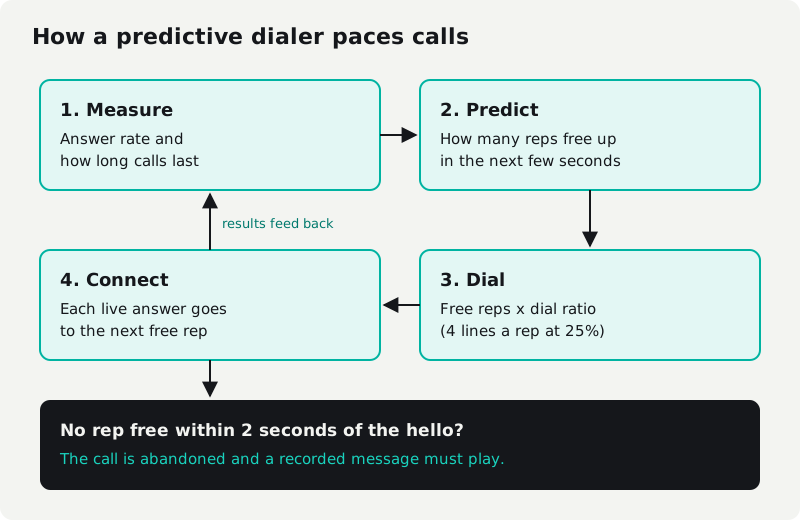
The weak spot is step 4. When more people answer than there are free reps, the extra calls have nowhere to go. The person says hello and hears silence, then a hang-up or a recorded message. That pause is the dead air people notice when a sales call picks up.
Answering machine detection makes the pause longer. The dialer listens to the first moment of the call to decide if it reached a person or a voicemail. When we ran a predictive dialer, that pause after people said hello lost them. Some hung up, and our numbers got flagged as spam, which burned more leads.
Predictive dialer vs power dialer
A predictive dialer calls ahead of your reps, several lines each, and accepts some abandoned calls to keep everyone talking. A power dialer calls one number for each free rep and waits for that rep, so a live answer almost never goes unanswered. Predictive suits a big floor on a cold list. Power suits nearly everyone else.
| Mode | Lines per free rep | Who decides when to dial | Abandoned calls |
|---|---|---|---|
| Preview | 1, after the rep reviews the record | The rep | None |
| Power or progressive | 1 | The dialer, when a rep is free | Almost none |
| Parallel | 2 to 10 | The dialer, one batch per rep | When two people answer |
| Predictive | Several, set by the software | The software, ahead of free reps | Some, up to the 3% limit |
Vendors use these names loosely, so the table uses our definitions. Five9's dialer modes, for example, call a dialer that runs a set number of calls per agent "power", while most sales tools mean one line. Our power dialer guide covers that side in depth, with seat prices.
Predictive dialer vs progressive dialer
A progressive dialer places one call for each available rep and adjusts its pace from campaign results, so it drops far fewer calls than a predictive dialer. Five9 recommends progressive mode under 10 active agents and predictive above that. In most sales tools, "progressive" and "power" mean the same 1:1 dialing.
Predictive dialer vs auto dialer
An auto dialer is any software that places calls for you, and a predictive dialer is one kind of auto dialer. Power, parallel and preview dialers are auto dialers too. So the real question is which kind of auto dialer fits your team, and that comes down to how many reps work the same list at once.
When does predictive dialing fail? How many reps you need
Predictive dialing fails when too few reps share a campaign. With a small pool, the dialer can't count on someone freeing up when an extra call connects, so it either drops live answers or slows to one line per rep. Most vendors put the floor at about 10 to 15 reps logged in to the same campaign.
| Vendor | Team size it recommends for predictive |
|---|---|
| Close | At least 4 logged in, 10 or more ideal |
| JustCall | 5 or more agents per campaign |
| Five9 | More than 10 active agents |
| Genesys Cloud | At least 15 logged in |
Close says outright that a rep dialing alone is unlikely to see the call rate rise above 1x. The math shows why. In the chart below we assume 25% of calls get answered and each answer is independent, then count how many live answers find no rep free.
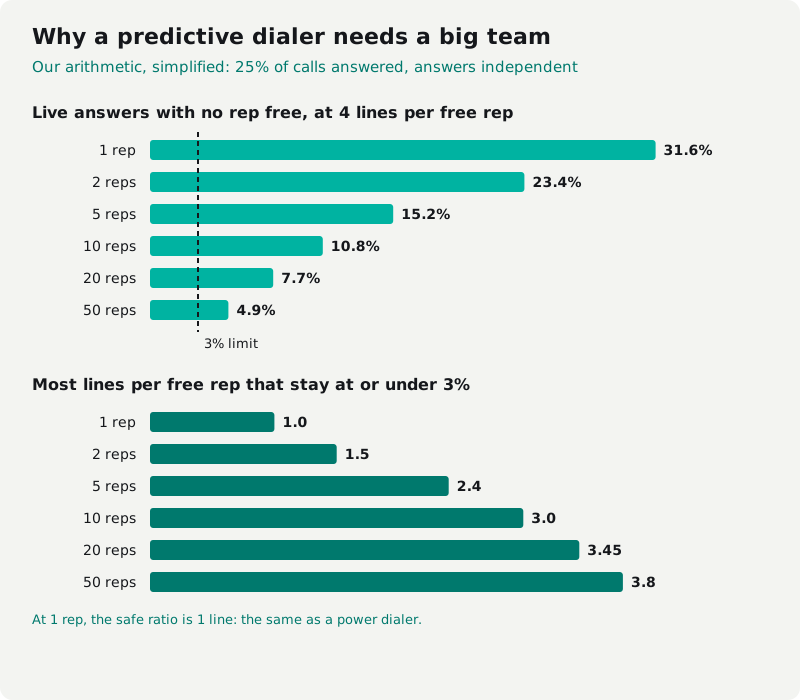
At the textbook 4 lines per rep, every team size abandons more than 3%. To stay under it, a 10-rep campaign can run about 3 lines a rep, and a single rep only 1. At that point the predictive dialer is just a power dialer with a bigger bill.
Four other ways it goes wrong:
- Split campaigns. Twenty reps across two campaigns is two pools of 10, not one of 20. Genesys Cloud's own guide uses that example.
- A list that answers too often. Warm leads and callbacks pick up more, so a ratio set for cold lists over-dials them.
- The list burns fast. On predictive and parallel dialing, a fairly small team of ours went through about 30,000 leads a month. Price your data before you price seats.
- The hello pause. Answering machine detection plus no free rep reads as a robocall. People hang up, and the number gets flagged as spam.
Are predictive dialers legal?
Predictive dialers are legal in the US, but the abandoned calls they cause are capped. For telemarketing calls, the FCC rule bars abandoning more than 3% of calls answered by a live person, per campaign over each 30-day period. A call is abandoned if it isn't connected to a live rep within two seconds of the person's completed greeting. When no rep is free, a recorded message has to play with the business name and a number for do-not-call requests, and you have to keep records.
The FTC's Telemarketing Sales Rule treats the same 3% as a safe harbor, along with letting unanswered calls ring at least 15 seconds or four rings. The 3% is counted against answered calls, not dials: 1,000 live answers in a month allow at most 30 abandoned calls.
A predictive dialer isn't automatically an "autodialer" under the TCPA. The Supreme Court held in Facebook v. Duguid (April 1, 2021) that an autodialer needs the capacity to use a random or sequential number generator. Consent, Do Not Call lists, calling hours and state laws still apply to every kind of dialer.
Our TCPA rules for sales calls cover those. This is not legal advice.
Predictive dialer cost
A predictive dialer costs about $50 to $300 a seat a month where the price is published, and many vendors only sell it by quote. Predictive mode usually sits on a top plan or a contact-center product, not on the plan a small sales team starts with.
| Vendor and plan | Per seat a month | 10 seats | 25 seats | 50 seats |
|---|---|---|---|---|
| Voiso Pro | $52 yearly, $65 monthly | $520 | $1,300 | $2,600 |
| Close Scale | $139 yearly, $149 monthly | $1,390 | $3,475 | $6,950 |
| ReadyMode iQ | $249 yearly, $299 monthly | $2,490 | Quote (20+) | Quote (20+) |
| JustCall SalesPro | Quote only, 2-license minimum | Quote | Quote | Quote |
| Five9, Convoso | Quote only | Quote | Quote | Quote |
| Cleanform, owned, no seat fees | $0 | $0 | $0 | $0 |
Cleanform is $0 a seat at any team size: you pay monthly for the build until it's paid off, then mostly hosting. How pricing works.
Seat math uses the yearly price. Calls, phone numbers and fees come on top: Voiso bills phone usage separately unless you add its $149-a-seat Unlimited option, Close charges about $0.02 a minute for most outbound calls, and ReadyMode includes up to 75 numbers per iQ license. JustCall keeps predictive on SalesPro, and its Pro, Pro Plus and Business plans can try it on up to 3 predictive campaigns. For every vendor that really sells predictive mode, with a dated price list, see predictive dialer software: vendors and prices.
Should you rent or own a predictive dialer system?
Rent a predictive dialer system if your dialer bill is under $1,000 a month: ten Voiso Pro seats at $520 a month is fine, and switching won't pay. Owning starts to make sense around $2,000 to $3,000 a month or more, which is where ten ReadyMode iQ seats ($2,490) or 25 Close Scale seats ($3,475) land.
A dialer you own can pace the way your floor works: power for a small team, predictive once the floor is big enough, with the script, dispositions and pipeline in one screen and no fee for the next hire. One sales team we built for paid about $4,500 a month for a per-seat dialer, a per-seat CRM, a scheduling tool and a Zap for eight closers. Now it pays about $300 a month in hosting, and an added seat costs $0 (the dialer and CRM case study).
The dialers we build also watch their own numbers. A nightly check reads each number's spam label on every carrier, rests a number that every carrier flags, and retires one flagged twice. Calling-hour limits run in each customer's local time, and your do-not-call list is checked before every dial. These are tools that help you follow the rules, not legal advice, and you're still responsible for your own compliance.
On cost: typically less than you spend today, paid monthly, and the build payments have an end date. You own the code and the data. Here's how pricing works.
Sources
Vendor pages and federal rules checked October 29, 2026.
- Close predictive dialer help and Close pricing
- JustCall predictive dialer, JustCall pricing and JustCall sales dialer FAQ
- Five9 dialer system
- Voiso pricing
- ReadyMode pricing and Convoso pricing
- Genesys Cloud predictive dialing best practices
- 47 CFR 64.1200 (FCC) and 16 CFR 310.4 (FTC)
- Facebook, Inc. v. Duguid, No. 19-511 (2021)
The SaaS cost calculator adds up your dialer, CRM and the rest of your stack in about two minutes. If it comes out at a few thousand a month, book a free audit and we'll show you what one owned system would replace.
Frequently asked questions
What is a predictive dialer?
A predictive dialer is outbound calling software that dials more numbers than you have free reps and connects only the calls a person answers. It predicts how many lines to dial from the share of calls that get answered and how long reps stay on each call.
How does a predictive dialer work?
A predictive dialer measures the answer rate and call length, predicts how many reps will be free in the next few seconds, and dials that many reps times a ratio, about 1 divided by the answer rate. At a 25% answer rate that is about 4 lines per free rep. Each live answer goes to the next free rep.
Is a predictive dialer legal?
Yes, with limits. For telemarketing calls, the FCC and FTC rules both use a 3% cap on abandoned calls, measured against calls a person answers, per campaign over 30-day periods. A call is abandoned if no rep picks up within two seconds of the person's hello, and a recorded message must play. Consent and Do Not Call rules still apply. This is not legal advice.
How many agents do you need for a predictive dialer?
About 10 to 15 agents logged in to the same campaign. Close recommends at least 4 and calls 10 or more ideal, Five9 recommends predictive mode for more than 10 active agents, and Genesys puts the line at 15. Below that, a power or progressive dialer usually gets more done.
What is the difference between predictive and power dialers?
A power dialer calls one number for each free rep and waits for that rep, so a live answer almost never goes unanswered. A predictive dialer calls ahead of the reps, several lines each, and accepts some abandoned calls in exchange for more talk time an hour on a big team.